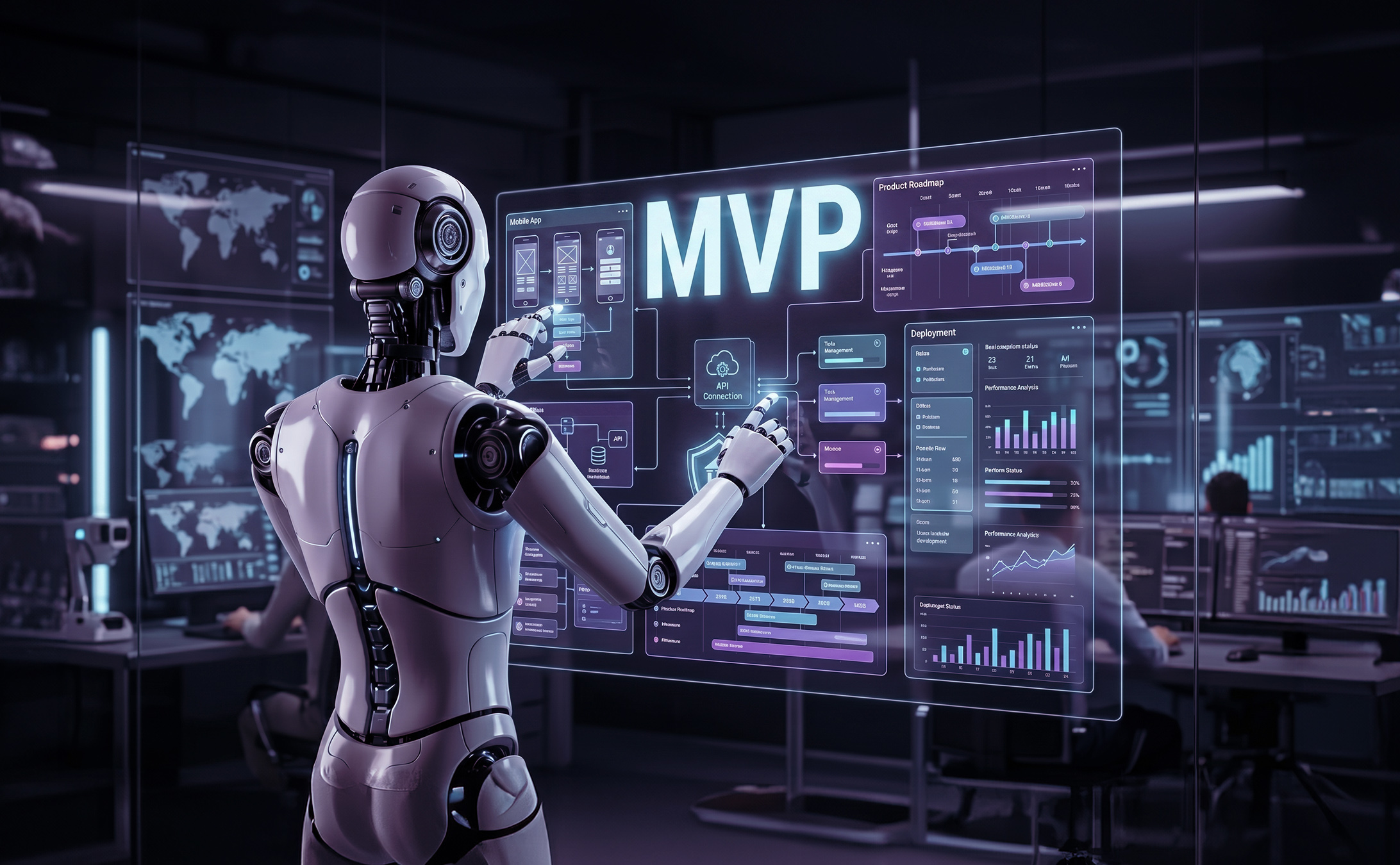
Build and Launch Ideas in Weeks With AI MVP Development
If you’re trying to test an idea, the real question is simple: How fast can you validate it without wasting time or budget?
AI-powered MVP development changes that timeline. What used to take months can now be done in weeks—without cutting corners on quality or clarity. Early-stage decisions become more informed, feature sets become tighter, and the risk of building the wrong product drops significantly.
Recent industry findings suggest that AI-supported product decisions can improve early-stage accuracy by up to 40%, especially when validating features and user demand.
This is why many founders now start with an MVP development company that integrates AI into planning and execution, rather than relying on traditional build-first approaches.
Why speed alone is not the goal?
Faster development sounds attractive, but speed without direction creates problems. Many MVPs fail not because they are slow, but because they are built around assumptions.
AI changes this by answering key questions early:
- What problem actually matters to users?
- Which features are worth building first?
- Where are users likely to drop off?
Instead of debating internally, teams work with data-backed signals. AI MVP development reduces rework and keeps the build focused.
What AI changes in MVP development?
AI doesn’t replace development. It reshapes how decisions are made before and during it.
1. Better validation before writing code
Traditional MVPs often rely on surveys or limited research. AI analyses broader signals—search behaviour, competitor gaps, and user intent—to validate ideas more realistically.
Studies highlighted in business research show that AI-backed validation can be up to 2x more reliable than survey-only approaches.
This means fewer false starts.
2. Smarter feature prioritisation
One of the biggest delays in MVP projects is deciding what to build. AI models evaluate:
- Market demand
- Competitor features
- User expectations
Then rank features based on likely impact. Instead of building everything, teams focus on what matters first.
3. Faster prototyping and iteration
AI MVP development tools can now generate:
- Wireframes
- User flows
- Basic interfaces
This reduces the time spent moving from idea to something testable. Founders can review, adjust, and test earlier.
We use AI to validate, prioritise, and build with clarity.Turn your idea into a working MVP faster with the right approach.

How the process typically works
A structured AI-powered MVP approach usually follows this path:
1. Problem definition
A clear business problem and target users are identified. At this stage, many teams confuse MVPs with PoCs. This often leads to misaligned expectations. Studying the MVP vs PoC comparison will help you avoid common early-stage mistakes.
2. AI-led validation
Data is analysed to confirm demand and refine the idea.
3. Feature scoping
Only high-impact features are shortlisted.
4. Rapid prototyping
Initial product versions are created quickly for feedback.
5. Iterative development
The MVP is built and improved in short cycles.
This is where MVP development services bring value. The right service provider or AI development company combines AI tools with practical engineering to keep things moving without overcomplicating the build.
AI vs. traditional MVP development
| Traditional Approach | AI-Powered Approach |
| Relies heavily on assumptions | Uses real data early |
| Longer validation cycles | Shortens validation time |
| Feedback comes late | Enables faster iteration |
| Higher risk of rework | Reduces wasted effort |
The difference is not just speed—it’s clarity at each step.
Real impact: a practical scenario
In one early-stage product case, a team tested multiple feature ideas using AI before development.
- Over 30 features were analysed
- Only a small subset showed strong engagement potential
- Prototype testing happened within days
- Development focused only on validated features
The result was a lean MVP and faster launch, with fewer changes required post-release. This is where AI makes a difference. It does not do everything, but it helps teams avoid unnecessary work. For example, building an MVP for a cyber safety app requires careful validation of user risks and real-world scenarios.
Benefits that matter in business terms
1. Reduced development waste
Fewer unnecessary features mean better use of the budget.
2. Faster time to market
Early validation removes delays later.
3. Better product-market fit
Decisions are based on behaviour, not guesswork.
4. More confident decision-making
Teams move forward with clearer direction.
Where does AI MVP development still need human input
AI is not a complete solution on its own. There are areas where human judgement remains critical:
- Defining the problem clearly
- Understanding business context
- Making strategic trade-offs
- Designing meaningful user experiences
A balanced approach works best, like using AI for insights, people for decisions.
Conclusion
AI-powered MVP development is not about replacing traditional methods entirely. It’s about making better decisions earlier, reducing unnecessary effort, and moving with more clarity. The businesses that benefit are the ones that build with purpose.
If you’re planning to launch a product, working with a software development company that understands both AI and practical execution can make the difference between testing an idea and building something that actually works.
FAQs
What do you mean by AI-assisted development?
It means consistent use of AI tools and data models for building a minimum viable product. AI plays a pivotal role in guiding decisions during planning, validation, and development. This helps to reduce guesswork and improve accuracy in the first launch.
How much does building an AI-powered MVP cost?
The cost of making an MVP is influenced by many factors, such as:
- Complexity
- Number of features (1 or a few)
- Chosen technology stack
- Product timelines
AI-led approaches help to reduce repetitive tasks via automation. This helps control overall expense.
Who owns the code?
The client retains full ownership of the codebase once the project is delivered. We always define this clearly at the very start of the project.
What happens if my product needs to scale later?
Yes, we build MVPs with scalability in mind. The initial version is lean, but the architecture allows future expansion without rebuilding everything.