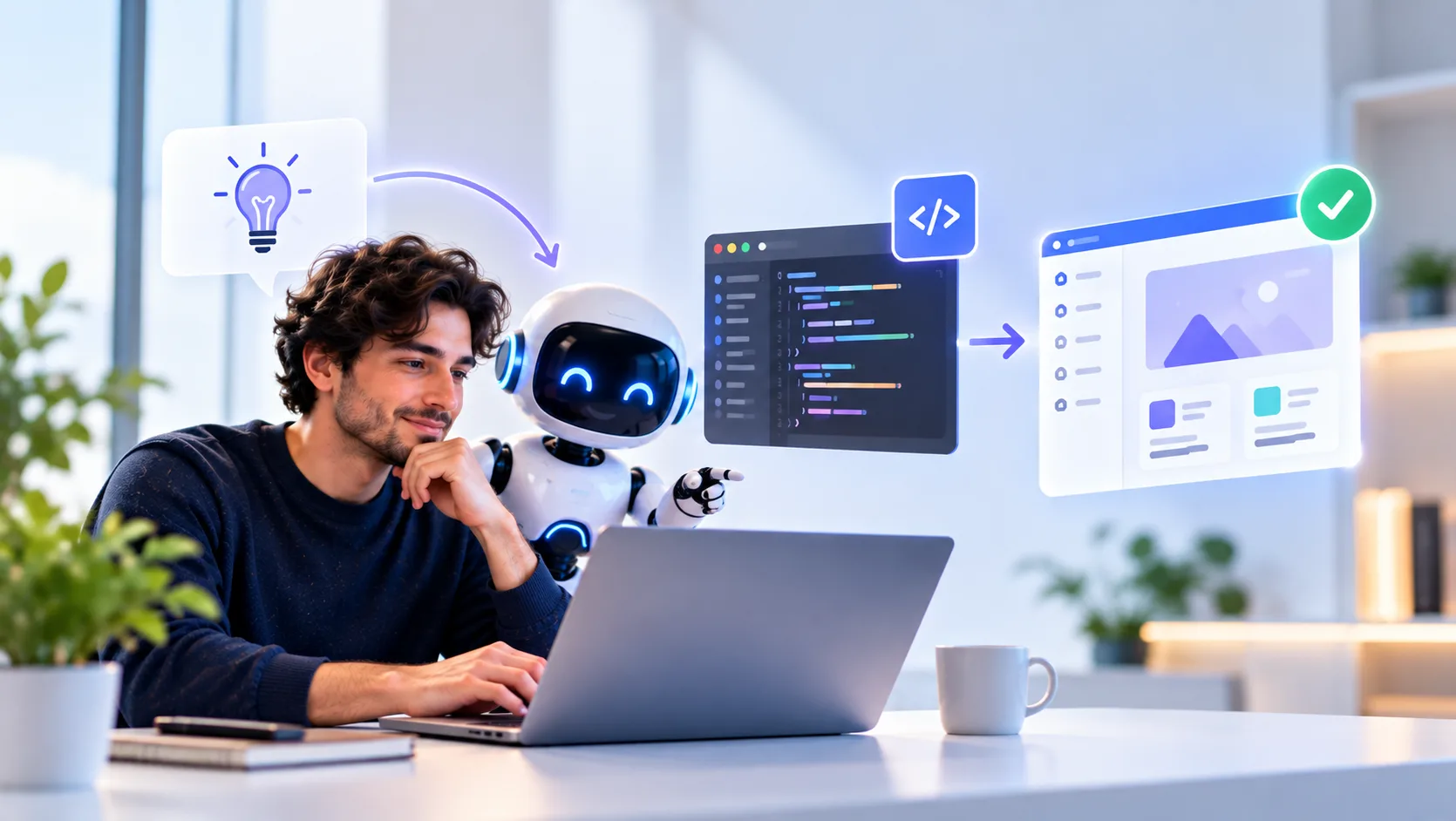
Vibe Coding: Can You Really Build Production-Ready Software With AI?
AI tools now make it possible for someone with no coding experience to build a working app in a few days. They describe what they want, the tool writes the code, and the result looks ready to launch. The harder question comes next: is it safe to put in front of customers?
Nowadays, many businesses are asking this question while comparing AI development services. AI can help you build production-ready software. But an app that is mostly built by vibe coding often needs some more work before it can be used by real users with real data.
In this article, we’ll look at what vibe coding is, where it falls short, and what it takes to turn an AI-built app into software you can safely launch.
What is vibe coding?
Vibe coding is a way to make software in which you tell an AI tool what you want in natural language, and it writes the code. The person making the app is not designing its architecture. They enter a prompt, look at the output, and loop until the app works.
The term took off in early 2025, after AI researcher Andrej Karpathy used it in a post on X to describe this prompt-led approach. Tools such as Cursor, Replit, and Lovable have since opened it up to people with no programming background.
It’s genuinely useful for prototypes, internal tools, and testing an idea before committing a budget to it. Trouble starts when a prototype goes live as the finished product without further checks.
How many businesses are using AI to write code?
A lot, and the number is increasing fast. Gartner predicts that by 2028, 90% of enterprise software engineers will use AI code assistants, up from less than 14% in early 2024.
That doesn’t mean most software will be vibe coded. Most professional teams use AI to support a structured process. It does mean that AI-written code will sit inside most of the systems your business relies on, including those built by your suppliers. Knowing how to check its quality is now part of buying software.
Why isn’t vibe-coded software ready for production?
AI tools are built to produce code that works in demos. Real users, unexpected data, and future changes pose challenges for production software, and AI-generated prototypes seldom undergo testing to address these issues.
Common problems in vibe-coded applications include:
- Security gaps. Login systems, access controls, and checks on user input are often incomplete or missing.
- No automated tests. Without them, a new feature can quietly break an existing one, and you may only find out when a customer reports it.
- Poorly organised code. As the app grows, the AI loses sight of how the whole system fits together. That leads to repeated logic and changes that cause errors elsewhere.
- No documentation. If nobody on your team understands how the code works, fixing or extending it becomes slow and risky.
An app can look finished and still have all four.
Find out before you launch. Our team will review your code and show you what needs fixing.Is Your AI-Built App Ready for Real Customers?
What does production-ready software mean?
Production-ready software is software you can launch, run, and update safely without putting your business at risk. It doesn’t need to be perfect. It does need to be reliable.
When our engineers assess a codebase, they check whether:
- It behaves correctly, including in unusual situations.
- Automated tests catch errors before each release.
- A new developer could understand and change the code.
- Logging and monitoring show what went wrong when something fails.
- Personal data is handled in line with UK GDPR.
If you can’t confirm most of these, the app is still a prototype.
Can AI-assisted development produce production-grade software?
Yes, AI can produce production-grade software when it operates within a proper engineering process. AI writes code quickly. What it can’t reliably do is decide what should be built, how the system should be structured, or whether a change is safe to release. Those calls still need experienced engineers.
Teams that get excellent results give AI clear instructions and check its work. Engineers set the architecture and testing standards, review every change, and run automated checks before anything reaches customers. AI speeds up delivery, and the process protects quality.
That’s how well-run AI development services put AI to work. Each tool is picked for a specific task, and AI-generated code gets the same review as code a developer wrote by hand. Nothing ships until the team understands it.
Should you fix a vibe-coded app or rebuild it?
It depends on the quality of the existing code. Many vibe-coded apps are worth keeping: the idea has been tested, the screens work, and users find the app useful. What they usually need is stronger security, automated tests, and a data structure that can handle more users.
Sometimes, though, the code is too disorganised to fix safely, and repairing it would cost more than rebuilding it properly.
It’s hard to tell which applies without a detailed look at the code. An independent review from an experienced AI consultant in the UK can show you where your app stands before you spend more on new features.
How does Coding Sprint take AI-built software into production?
AI-led development is how Coding Sprint builds software every day, so our team knows exactly where AI-generated code tends to fall short. Every project starts with discovery. Our engineers review the code, talk to the people who built and use the app, and confirm what your business needs it to do. You then get a clear recommendation: strengthen the existing app, rebuild parts of it, or start again. Once the scope is agreed, the price is fixed.
The work usually covers:
- security improvements
- restructuring the code
- automated testing and deployment pipelines
- monitoring
- documentation for your own team
At the end, you own a codebase your team understands and can keep developing, whether that’s with us, with your own developers, or with AI tools.
Is vibe coding worth it for your business?
Yes, as a fast way to test ideas and show stakeholders a working example. Just treat it as a first step. Before an AI-built app handles customer data or takes payments, it needs the same checks as any other business software.
If you’ve built an app with AI and want to know how close it is to being production-ready, talk to Coding Sprint. As an AI consultant in the UK, we’ll review your app, identify any gaps, and explain what needs to be addressed before launch.
Frequently asked questions
Is vibe coding safe for business applications?
It’s generally safe for prototypes and internal testing. Any app that stores customer data or takes payments should have a security review before launch, because AI tools often leave out important protections.
How long does it take to make a vibe-coded app production-ready?
Usually one to three weeks, depending on the app. A small, well-structured app can be ready pretty fast. Before launching anything that handles payments or personal data, a proper execution of security checks, testing, refactoring, and monitoring is needed, and this extends the timeline.
Do developers still need to review AI-generated code?
Yes. Artificial intelligence is able to write code that looks like it works, but has bugs, security holes, or bad structure. Reviews by experienced developers, backed by automated tests, are the most reliable way to catch these problems.
Can non-technical staff use vibe coding?
Yes, it’s a useful way to test ideas and map out workflows. The danger is when those early versions go live without an engineer looking at them first.