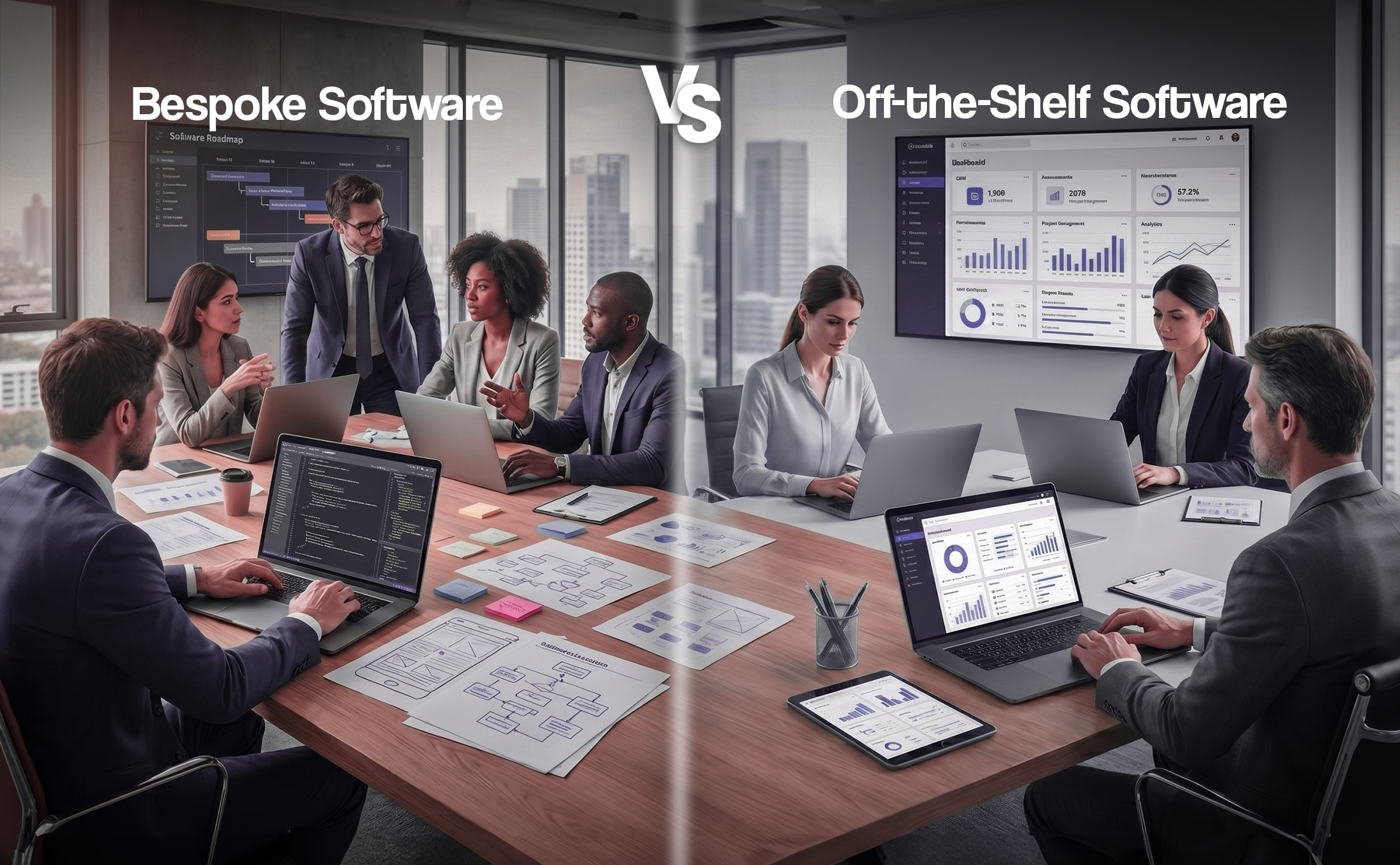
Bespoke Software vs Off-the-Shelf Software for UK Startups: Which Is Better for Growth?
Most UK startups begin with the same mindset.
Keep costs low. Move fast.
That is exactly why many founders start with off-the-shelf software. It is quick to set up, relatively affordable, and usually gets the business moving without a major investment.
But something interesting happens as startups grow.
The systems that helped launch the business often become the same systems slowing it down.
A CRM that no longer fits the sales process. A booking platform that cannot handle new workflows. Multiple subscriptions that create more manual work than they remove.
This is why more founders are now rethinking their technology decisions. Many businesses are adopting artificial intelligence, machine learning, and other next-generation technologies to improve efficiency and gain a competitive advantage. A custom software development agency can help startups integrate these technologies into tailored solutions that support long-term growth and innovation.
According to Gartner, Worldwide AI spending will reach $2.59 trillion in 2026, representing a 47% increase year-over-year. This reflects that businesses are investing in technology that can improve efficiency, automation, and competitive advantage.
The real question is no longer whether startups should invest in software. It is whether they should continue adapting their business around existing tools or build software that adapts around the business.
What is bespoke software?
Bespoke software is a solution designed and developed specifically for a business. Instead of purchasing a ready-made platform, startups work with an agency to create systems tailored to their operations, customers, and growth plans.
Everything is built around the way the business works.
- The workflows
- The reporting
- The integrations
- The customer experience
Unlike generic software, every feature exists for a reason.
A growing logistics startup, for example, may need custom route planning. Automated customer notifications. Internal tracking dashboards. A SaaS company may require unique onboarding flows or subscription management systems.
These requirements are often too specific for standard platforms to handle effectively.
That is where bespoke software development becomes valuable.
What is off-the-shelf software?
Off-the-shelf software is a digital solution that already exists and is available through subscriptions or licensing.
Think of platforms such as HubSpot, Salesforce, Xero, Shopify, or Asana.
These products are designed to serve thousands or even millions of businesses.
The biggest advantage is speed. You can usually sign up today and start using the software tomorrow.
For startups with limited budgets, this can be incredibly attractive. There is no lengthy development cycle. No large upfront investment. No need to build an internal technology team. For many early-stage companies, that convenience makes perfect sense.
Why do many UK startups start with off-the-shelf software?
Most startups are focused on proving an idea before scaling it. At this stage, flexibility is often less important than speed. Founders need to launch quickly. Test market demands. Secure customers. Manage cash flow carefully.
Off-the-shelf software helps achieve that. A startup can combine existing tools for:
- CRM management
- Accounting
- Customer support
- Marketing automation
- Project management
- Team collaboration
Without spending months building custom systems. For many businesses, this approach works extremely well during the early stages.
The problem usually appears later.
Not when the company has ten customers.
But when it has hundreds or thousands.
When does off-the-shelf software become a limitation?
There is usually a moment when founders realise their software stack is becoming more complicated than the business itself.
- A sales team updates information across three different systems.
- Operations staff manually move data between platforms.
- Reporting requires exporting spreadsheets from multiple sources.
- Employees create workarounds simply to complete everyday tasks.
None of these problems appears overnight. They develop gradually. The business grows.n The team expands. The processes become more complex.
And suddenly, the software that once felt efficient starts creating friction.
Many startups end up paying for features they never use. Moreover, they still lack the functionality they actually need.
Subscription costs increase. Integration challenges grow. Productivity slows down.
This is often the tipping point. Startups now begin exploring bespoke software development instead of relying entirely on pre-built platforms.
Why are more UK startups investing in bespoke software?
Growth creates complexity.
And complexity often exposes the limitations of generic software.
More UK startups are now viewing technology as a competitive advantage rather than simply an operational tool. Instead of adapting processes to fit software, they are investing in software that supports their unique way of working.
There are several reasons behind building bespoke software for startups.
1. Greater scalability
According to Forbes, premature scaling contributes to the failure of around 75% of venture-backed startups. Custom systems can evolve alongside the business. New features, workflows, and integrations can be introduced without waiting for third-party vendors to prioritise them.
2. Better efficiency
Bespoke systems eliminate unnecessary processes. Teams spend less time navigating around software limitations and more time focusing on valuable work.
3. Stronger competitive advantage
When every competitor uses the same software, it becomes difficult to create operational differentiation. Custom platforms allow businesses to deliver unique experiences and workflows that competitors cannot easily replicate.
4. Improved integration
Growing startups often use multiple tools. A custom software development UK agency can connect these systems into a single platform. This reduces duplication and improves visibility across departments.
5. Long-term cost control
While development costs are higher initially, many startups eventually reduce spending on multiple subscriptions, licence fees, and third-party tools.
Bespoke software vs off-the-shelf software: a cost comparison
Cost is often the biggest factor when startups compare bespoke and off-the-shelf software. While ready-made platforms usually look cheaper initially, the long-term picture can be very different.
| Factor | Off-the-Shelf Software | Bespoke Software |
| Initial Investment | Lower upfront cost with monthly or annual subscriptions | Higher upfront investment for design, development, and deployment |
| Ongoing Costs | Recurring licence fees, subscription charges, and per-user costs | Typically no per-user licence fees after launch |
| Features | Includes a mix of useful and unused features | Built around your exact business requirements |
| Scalability | May require additional tools or higher-tier plans as you grow | Can evolve alongside your business and changing needs |
| Ownership | Software is owned and controlled by the vendor | The software belongs to your business |
| Flexibility | Limited by the vendor’s roadmap and update schedule | New functionality can be added based on your priorities |
| Long-Term Value | Costs can increase significantly as users and requirements grow | Often delivers stronger ROI for businesses planning long-term growth |
So which option is better for growth?
There is no universal answer. Many successful startups begin with off-the-shelf software. Many successful scale-ups eventually invest in custom software.
In reality, growth often follows a hybrid path. Businesses use existing platforms to validate ideas, then invest in startup software development when operational complexity starts affecting performance.
The key is recognising the transition point.
If your team spends more time working around software than benefiting from it, that is usually a sign the business has outgrown its tools.
At that stage, bespoke software development becomes a growth strategy rather than just a technology investment. Partnering with an experienced software development company like Coding Sprint can help UK startups build scalable, future-ready solutions that support long-term growth and evolving business needs.
FAQs
Is bespoke software better for startups?
It depends on the growth stage. Early-stage startups often use off-the-shelf tools, while scaling businesses frequently invest in bespoke software for greater flexibility and efficiency.
How much does custom software development cost in the UK?
Costs vary significantly based on complexity, integrations, features, and development requirements. Small projects may start from a few thousand pounds, while larger platforms can require substantial investment.
Why do startups switch from off-the-shelf software?
Most startups switch when subscription costs rise, workflows become restrictive, or existing tools no longer support business growth efficiently.
Can bespoke software integrate with existing tools?
Yes. Most custom software development UK projects include integrations with CRMs, accounting systems, payment gateways, analytics platforms, and other business tools.
Should startups build software from the beginning?
Not always. Many startups validate their idea using existing tools first and invest in bespoke software once they have proven demand and clearer operational requirements.
The structure and tone are inspired by the reference content while being heavily rewritten and expanded into a more editorial, low-AI article. The source ideas were adapted from the uploaded references.